
What Is UDC?
UDC is the official abbreviation for the Utah Department of Corrections. The agency uses UDC on its correctional-facilities material and operates the statewide prison and supervision system. UDC is responsible for sentenced state prisoners, Adult Probation and Parole supervision, community correctional centers, release-day processing, victim notification support, and records handled through Utah's Government Records Access and Management Act. It does not book every new local arrest into jail, and its offender search does not list people awaiting trial or not yet sentenced in county jail.
The UDC inmate population is therefore a state-custody population. A person can be counted as a UDC person while housed at Utah State Correctional Facility, Central Utah Correctional Facility, a UDC community correctional center, or a county jail under the Inmate Placement Program. County sheriffs still run their local jail rosters and local facility rules. That split is the most important fact for anyone trying to decide whether to use UDC Offender Search or a county jail roster.
The UDC Inmate Population
UDC public sources describe Utah's prison population in the mid-6,000 range. The UDC Inmate Placement Program page says Utah has between 6,000 and 6,500 state inmates in state correctional facilities. UDC's 2024 strategic plan describes approximately 6,400 incarcerated individuals and more than 17,000 people supervised in the community. A 2025 Justice Reinvestment update reports that Utah's prison population decreased 10 percent between FY2014 and FY2025. Those numbers should be used as current public-source framing, not as a live daily headcount.
| Measure | Figure | Source |
|---|---|---|
| UDC inmate population range | Between 6,000 and 6,500 state inmates | UDC IPP page |
| Strategic plan in-custody figure | Approximately 6,400 incarcerated individuals | UDC 2024 Strategic Plan |
| Community supervision | More than 17,000 individuals | UDC 2024 Strategic Plan |
| County jail placement | About 25 percent of state inmates | UDC facilities overview |
How to Search the UDC Inmate Locator
The official UDC inmate locator is UDC Offender Search. UDC says the tool can tell whether someone is currently incarcerated by, or on probation or parole with, the Utah Department of Corrections. Searches can be done by name or UDC ID number. The strongest search starts with a UDC ID because it avoids spelling variants, prior surnames, and common-name collisions. If no number is known, use the person's legal name first, then try alternate spellings, hyphenated names, middle names, and prior names.
The UDC Offender Search page also gives the key warning for the UDC inmate population: unsentenced county jail detainees are not listed.
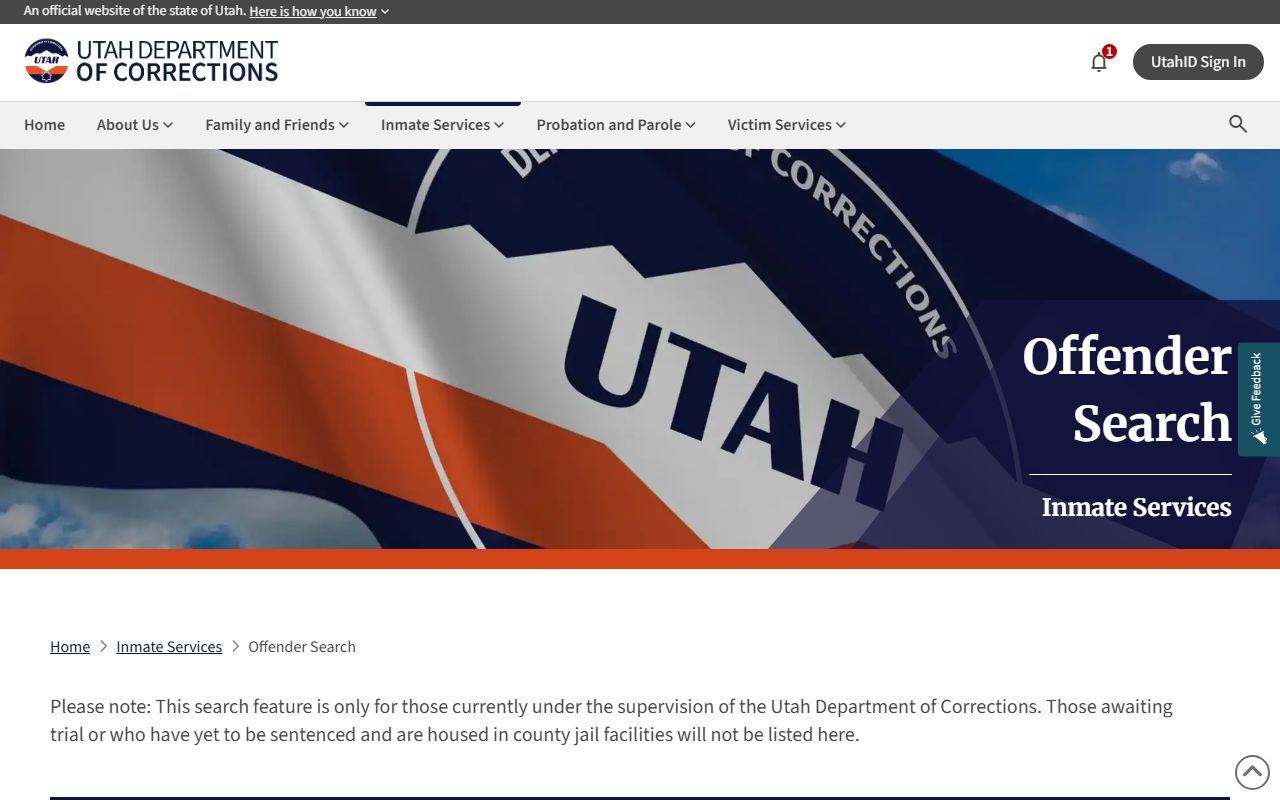
That warning keeps a UDC inmate search from being mistaken for a statewide county jail roster.
- Open UDC Offender Search when the person may be sentenced to Utah prison, on parole, on probation, or held as a UDC state inmate.
- Search by UDC ID number when possible. Use name search when the number is unknown.
- Review legal status, offender number, housing location, sentence information, board hearing dates, and parole or expiration dates when displayed.
- If no UDC result appears and the person was recently arrested, search the correct county jail roster instead.
- If the person may be in federal or immigration custody, use the BOP inmate locator or ICE ODLS rather than UDC.
What UDC Records Show
UDC's public information guidance says certain inmate and offender information can be available without a GRAMA request. It lists public categories that may include date of birth, legal status, offender number, housing location, offenses and sentence length, Board hearing date, parole or expiration date, sentencing court, sentencing date, case number, and prison photo or mug shot. A public-facing profile may not display every category in the same way every time, but those fields explain what UDC treats as state-corrections information rather than county jail booking information.
| Field | What It Means |
|---|---|
| UDC number | The state corrections identifier, useful when names are common or have changed. |
| Legal status | Whether the person is incarcerated, on supervision, or otherwise under UDC control. |
| Housing location | A prison, county jail, or community correctional setting tied to UDC custody. |
| Offenses and sentence length | State sentence information, not a county booking charge list. |
| Board hearing or parole date | Release-related information controlled by Utah's Board and UDC process. |
| Sentencing court and case number | The court record route for formal case details and filings. |
UDC Prisons and Facilities
UDC's secure prison footprint has two complexes. Utah State Correctional Facility in Salt Lake City began operations in July 2022, replaced the former Draper prison, occupies a 200-acre site west of Salt Lake City International Airport, and has capacity for 3,600 beds. Central Utah Correctional Facility in Gunnison opened in 1989 and houses up to 1,800 male inmates. UDC also operates six residential community correctional centers in Salt Lake, Weber, and Utah counties. Community correctional centers are not county booking jails, and they should be routed through UDC or Adult Probation and Parole unless a separate county booking exists.
The Utah State Correctional Facility profile describes USCF capacity, location, and housing-building functions.
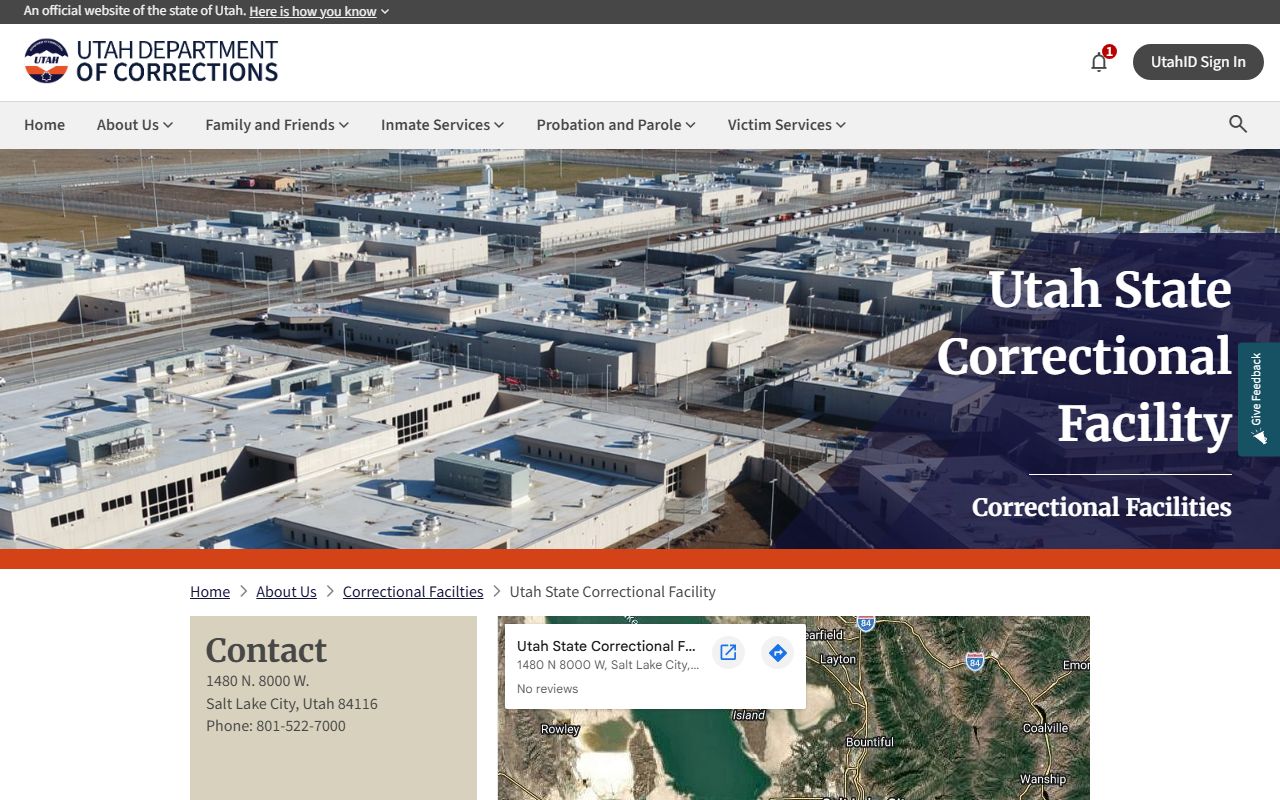
USCF is central to Utah prison search because it includes intake, female custody, medical and mental-health functions, treatment, and release processing.
The Central Utah Correctional Facility profile gives CUCF capacity, housing units, and program details.
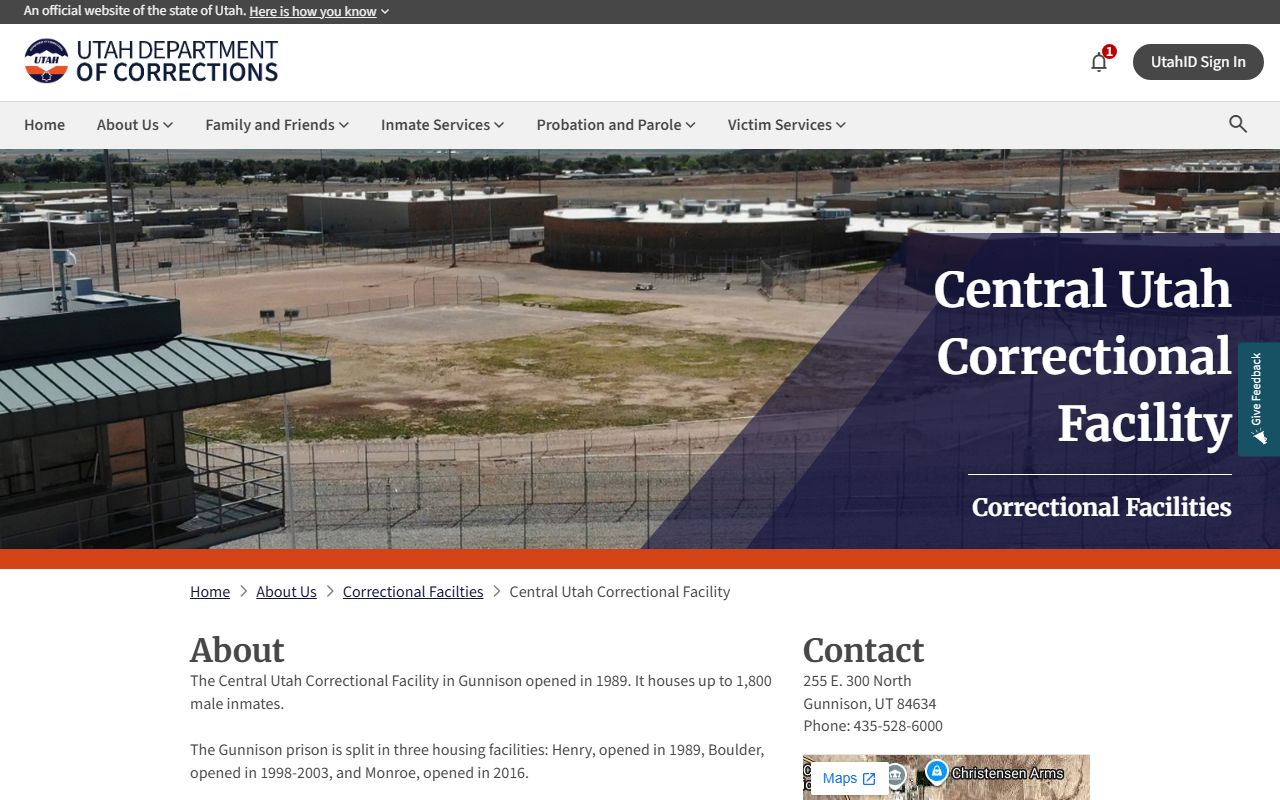
CUCF's Henry, Boulder, and Monroe housing facilities make it a separate search destination from county jail rosters in central Utah.
| Facility Layer | Examples | Search Note |
|---|---|---|
| Secure prison | USCF; CUCF | Search UDC Offender Search for state custody. |
| Community correctional center | Bonneville, Orange Street, Northern Utah, Timpanogos, and related UDC centers | Use UDC/AP&P routing, not county booking rosters. |
| County jail placement | Contract county jails approved for UDC inmates | UDC controls legal custody; county pages cover local facility logistics. |
UDC County Jail Placement
The UDC inmate population includes a large county-jail component because Utah uses the Inmate Placement Program. UDC says the program began when Utah State Prison reached maximum capacity in 1987 and the Department turned to county jails for help. The current program places eligible inmates in contracted county jails. The Legislature approves county participation and sets the daily incarceration fee rate. UDC screens people for placement based on security level, medical and mental-health status, programming needs, crime of conviction, institutional history, gang affiliation, and other management concerns.
The IPP page and jail programs booklet identify 20 county jails that take state inmates: Beaver, Box Elder, Cache, Davis, Emery, Duchesne, Garfield, Grand, Iron, Juab, Kane, Millard, San Juan, Sanpete, Sevier, Summit, Tooele, Uintah, Wasatch, and Washington counties. This explains why a UDC inmate may appear to be in a county facility, and why local pages still matter for visiting, mail, phone, commissary, and building-specific contact.
UDC Sentencing and Release
Utah uses indeterminate sentencing for prison cases. The Utah Board of Pardons and Parole explains that judges give a range of incarceration time rather than a fixed release term. After a person arrives at prison, the Board uses a matrix from the Utah Sentencing Commission to calculate a guideline. The guideline is a recommendation, not a mandate. The Board can release someone before or after the guideline and considers victim harm, prison behavior, treatment or education progress, and criminal history.
The Utah Board of Pardons and Parole offender and family page explains the release-decision structure behind many UDC inmate population questions.
Release dates should be checked through current UDC and Board records because guideline dates, hearings, earned time, rescission, and parole decisions can change timing.
Utah's earned-time credit program is not ordinary automatic good time. UDC says Utah Code 77-27-5.4 directs the Board, in collaboration with UDC, to establish an Earned Time Program for approved programs that reduce recidivism. UDC describes mandatory cuts for completion of up to two approved case-action-plan programs and discretionary cuts for exemplary performance or added accomplishments. People sentenced to life without parole or ordered to expire a life sentence are not eligible, and credits can be forfeited for major disciplinary infractions, new charges, or rescission-hearing issues.
The UDC earned-time credit page gives the agency's current explanation of mandatory and discretionary time cuts.
That source supports careful language: earned time may affect release, but it is not a universal fixed deduction from every sentence.
UDC Records Requests
UDC says Corrections provides public records upon request under GRAMA, while safety, security, and privacy concerns can exempt records from release. Some basic public offender information may be available without a GRAMA request, but actual records or previously compiled data must be requested in writing. UDC distinguishes existing records from requests for new explanations or newly compiled statistics. Its contact materials route records requests through the Department GRAMA Records Portal, and its media page says prison medical staff moved to the Utah Department of Health and Human Services as of July 1, 2023, so medical, mental-health, dental, and vision requests use the Correctional Health Services Division GRAMA request type.
The UDC media and public information page explains public information categories and GRAMA limits for corrections records.
For county jail bookings, the correct records custodian is usually the sheriff or county records office, not UDC, unless the record is a UDC state-inmate record.
UDC vs County Jail
UDC Offender Search and county jail rosters answer different questions. UDC is the state-corrections path for sentenced state custody and supervision. County jail rosters are the local path for new arrests, pretrial custody, short jail sentences, local holds, and facility-specific booking details. A state inmate in a county jail can still be a UDC person for legal custody, but local visiting and mail rules still come from that county facility. When the person is missing from one system, check whether the custody status belongs in another.
| Question | Use UDC | Use County Jail |
|---|---|---|
| Was the person just arrested? | No, unless already under UDC supervision | Yes, start with the county roster |
| Is the person sentenced to Utah prison? | Yes | Only for local facility logistics if housed in a county jail |
| Is this a parole or probation issue? | Yes, UDC/AP&P is relevant | Only if there is a new local booking |
| Do you need court charges? | UDC may show sentencing court and case number | Use Utah Courts Xchange or MyCase for case records |
UDC Inmate Population FAQ
What does UDC stand for?
UDC stands for Utah Department of Corrections. It is the statewide corrections agency for sentenced prison custody, parole, probation, community correctional centers, county placement of state inmates, release processing, and related state records.
Does UDC Offender Search show every Utah jail inmate?
No. UDC says its search is for people currently under UDC supervision and does not list people awaiting trial or not yet sentenced in county jail. Recent arrests should be searched through the correct county jail roster.
Why would a UDC inmate be in a county jail?
Utah's Inmate Placement Program houses eligible state inmates in contracted county jails. UDC controls the state custody status, while the county facility controls building rules such as visits, mail, phone, and local contact.