
Utah Court Records After Arrest
The arrest-to-court path has several records, and they do not all come from the same office. A sheriff or jail creates booking and custody records when a person is taken into local custody. A prosecutor then files formal charges, and those filings become the court record. Utah Courts says Xchange is a repository of public district court and justice court case information. That makes Xchange the statewide court-record source for many public case searches, while the county jail roster remains the custody source for who is physically in jail.
A court record after arrest is not proof of guilt. It can show a filed charge, a hearing, a warrant, a judgment, a plea, a dismissal, or another case event. It can also lag behind booking. A person may appear on a jail roster before the case is visible in Xchange, or a case may remain visible after the person is released. The two systems answer different questions.
The Utah Courts Xchange information page explains the statewide public case-search system and the records it displays.
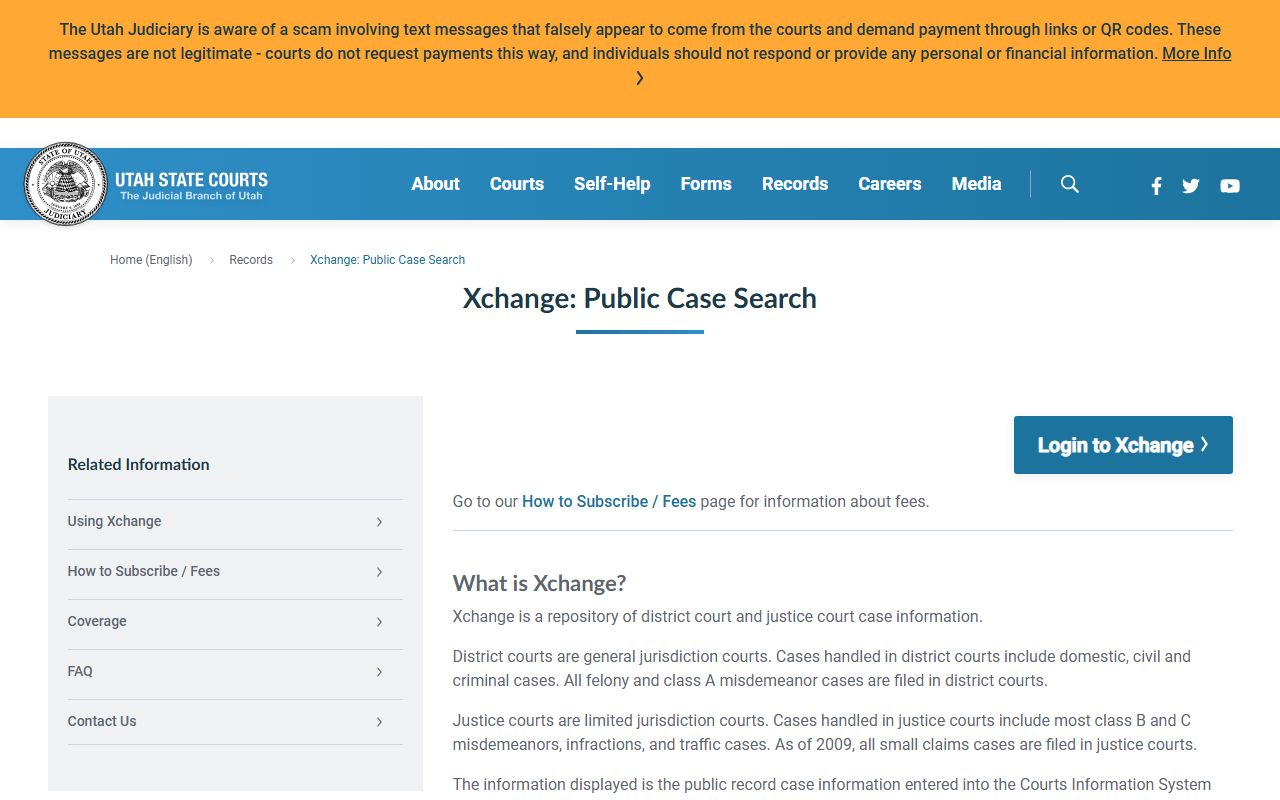
Xchange is the court side of the search, while custody and release status still come from the jail, UDC, BOP, ICE, or VINE source.
Utah Courts After Arrest
Utah Courts states that district courts handle domestic, civil, and criminal cases, and all felony and class A misdemeanor cases are filed in district courts. Justice courts handle most class B and C misdemeanors, infractions, and traffic cases. That split matters after a jail arrest because a person booked into a county jail may have a case in district court, justice court, or both depending on the charge level and filing decisions. Xchange draws public case information entered into CORIS by court staff and makes information available when entered into the local court's computer system.
The Utah Xchange portal is the public portal landing page for statewide case search.
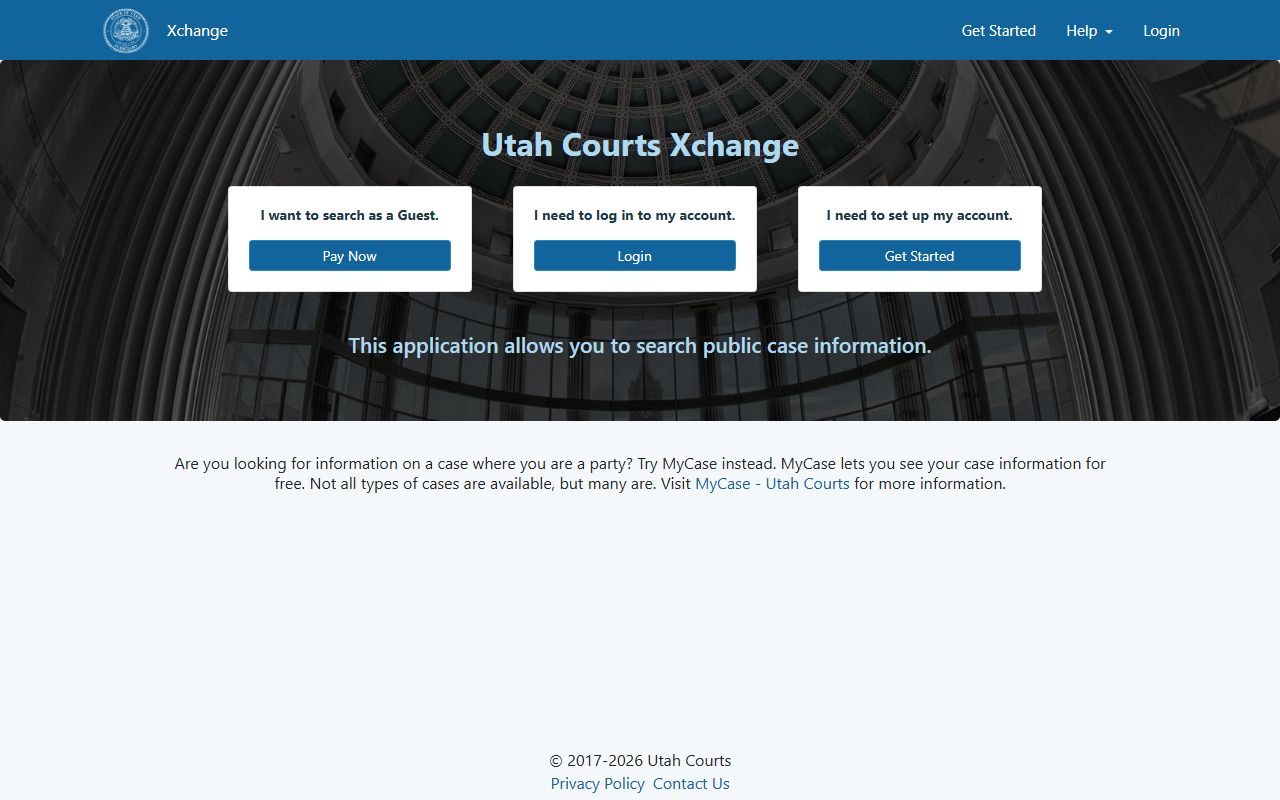
The portal should be used for case records, not as a substitute for a jail roster or a prison locator.
| Court Level | Criminal Scope | Search Use |
|---|---|---|
| District court | Felony and class A misdemeanor cases, plus other broad trial-court work | Search for serious criminal cases after arrest. |
| Justice court | Most class B and C misdemeanors, infractions, and traffic cases | Search for lower-level criminal and traffic matters. |
| MyCase | Party access when eligible | Use when the person is a party and needs eligible self-service records. |
Lookup Utah Arrest Court Records
Search in a sequence. Start with custody only when the first question is whether the person is still in jail. Move to Xchange or MyCase when the question is what was filed in court, what hearing is next, or what outcome was entered. Use the county of arrest, the person's legal name, and any case number from the jail roster, bond paperwork, citation, or court notice. If a charge was recently filed, check again later because court data appears when court staff enter it.
- Identify the county tied to the booking, citation, warrant, or jail hold.
- Search the county jail roster first if current custody is the urgent question.
- Search Utah Courts Xchange for public district and justice court case information.
- Use MyCase when the person is an eligible party to the case.
- Check UDC Offender Search only after a state sentence, supervision status, or prison transfer is possible.
The Utah Courts MyCase page is the party-access route, while Xchange is the public case-search route.
Charges After a Utah Arrest
Formal charges are different from a jail booking label. A booking record may reflect the arresting agency's reason for custody, but the court record reflects what prosecutors file and what the court accepts. Utah research for the statewide apex does not provide a county-by-county charging form inventory, so the statewide page should use general criminal-procedure terms without claiming a document exists in every case. The key distinction is simple: an arrest starts custody, and a filing starts the court case.
| Document or Event | Plain Meaning | Search Note |
|---|---|---|
| Complaint | A charging document used to start a criminal case in many prosecutions. | Look for it in the court record when public. |
| Information | A prosecutor-filed charging document used after screening or bindover in appropriate cases. | Case status can change after filing. |
| Indictment | A grand-jury charging document in cases where that route is used. | Do not assume every felony uses this path. |
Charge note: A filed charge is an allegation unless and until the court record shows a plea, finding, judgment, dismissal, or other outcome.
Utah Court Record Fields
Utah Courts says Xchange may provide summary information such as party names, party addresses if available, assigned judges, attorneys of record, documents filed, hearings held, judgments entered, and outcomes of completed cases. Public document images in district court cases are available for purchase on Xchange. Those fields help answer court questions after arrest, but they do not prove current jail location. A custody check still belongs with the county jail roster, UDC, BOP, ICE, or VINE.
| Field | What It Shows |
|---|---|
| Party name | The defendant or other case parties as entered by court staff. |
| Judge | The judge assigned to the case. |
| Attorneys | Attorneys of record when entered. |
| Documents filed | Public filings and document entries, with some district court images available for purchase. |
| Hearings | Hearings held or scheduled as entered in the case. |
| Judgment or outcome | Completed case outcomes when public and entered. |
Charge, Conviction, and Custody
Readers often confuse the arrest record, the filed charge, the conviction record, and the custody record. They can describe the same event chain, but each has a different source and meaning. A person may be arrested and booked, have charges filed later, be released before case completion, have charges dismissed, or be sentenced into UDC custody after conviction. Court records after a jail arrest should be read in that order rather than treated as a single yes-or-no status.
| Record | Source | What It Does Not Prove |
|---|---|---|
| Booking or jail roster | County sheriff or jail | Final guilt or case outcome |
| Filed charge | Prosecutor and court record | Conviction |
| Conviction or judgment | Court record | Current physical custody by itself |
| UDC record | Utah Department of Corrections | Every new county jail booking |
Sealed and Expunged Records
Utah Courts says records not open to public inspection are not displayed on Xchange. The nonpublic examples in the research include sealed cases, expunged cases, juvenile delinquency, child welfare, and termination cases. That limit affects court records after arrest because a missing public result does not always mean no record ever existed. It may mean the matter is sealed, expunged, juvenile, protected, not yet entered, outside Xchange's public scope, or in another system.
| Status | Public Search Effect | Practical Meaning |
|---|---|---|
| Sealed | Not displayed for public inspection | Use official court process, not public search guesses. |
| Expunged | Not displayed on Xchange | Do not treat missing public data as an error. |
| Juvenile matter | Generally outside adult public case display | Do not route youth cases through adult jail search. |
Court Records and UDC Custody
A court case may eventually lead to UDC custody, but only after sentencing and corrections processing. Utah uses indeterminate sentencing for prison cases, and the Board of Pardons and Parole controls central release decisions for many prison sentences. UDC Offender Search can show state custody or supervision, while Xchange can show court filings and outcomes. A court record after arrest is therefore the bridge between the county booking and any later UDC inmate population record.
The UDC offender search page is the state-corrections lookup after a person is sentenced into UDC custody or placed under supervision.
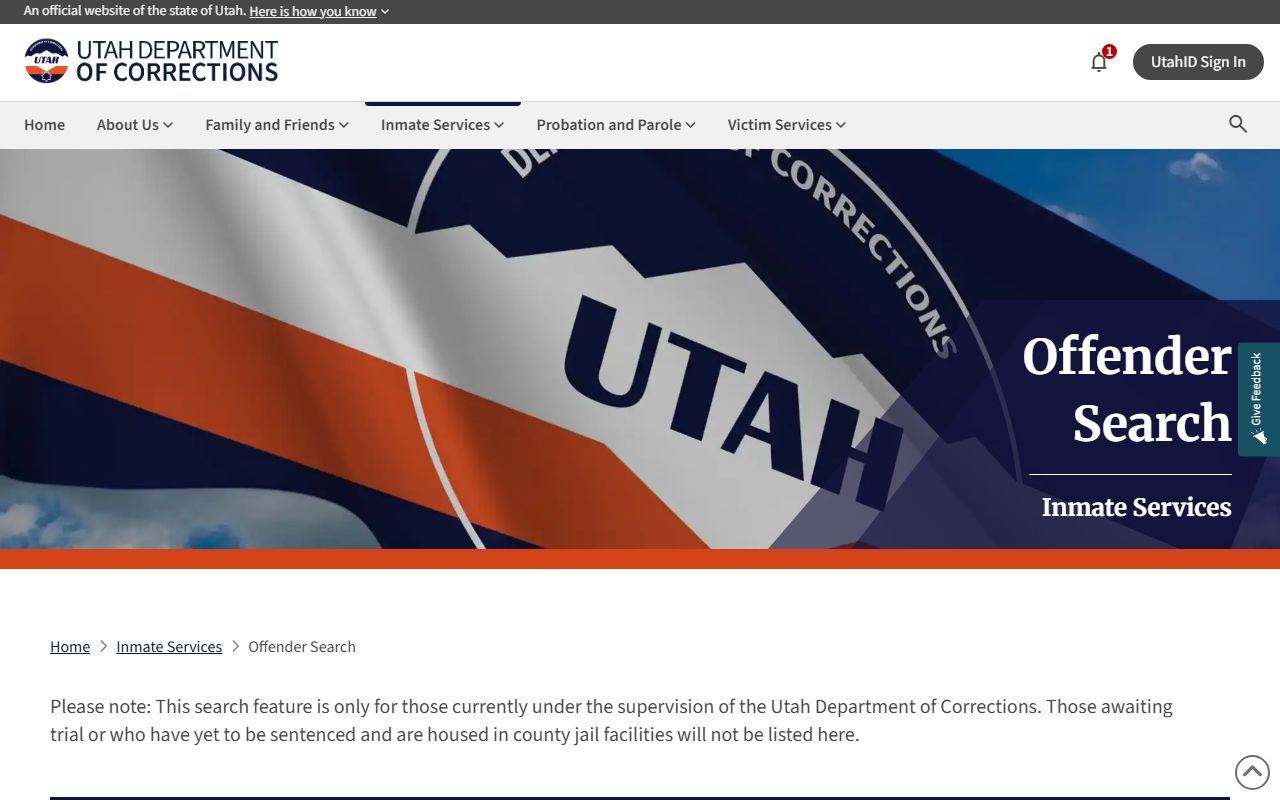
Use UDC for the prison or supervision record, then return to Utah Courts for case filings and judgments.
Release Alerts After Arrest
Utah VINE is the statewide automated victim notification system. Utah Courts says VINE provides information about custody status of offenders in Utah prisons and jails and lets users register for telephone or email notices when an offender is released, transferred, or escapes. UDC says the service is free, automated, available around the clock, and can be used with an inmate name or offender number. UDC also warns not to depend solely on VINE for protection.
The Utah VINELink portal is the statewide custody-notification tool tied to prison and jail feeds.
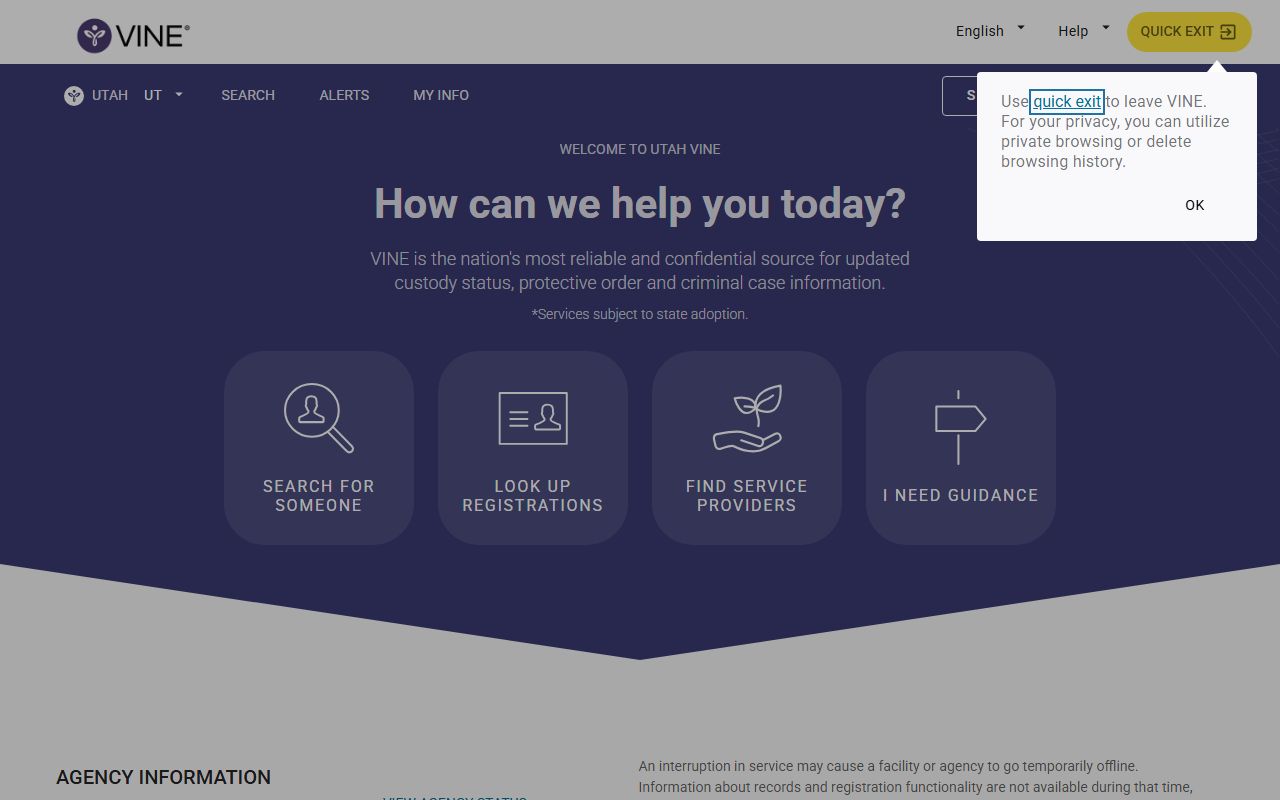
VINE can help monitor custody changes after a case starts, but court dates and filings still belong in the court system.